
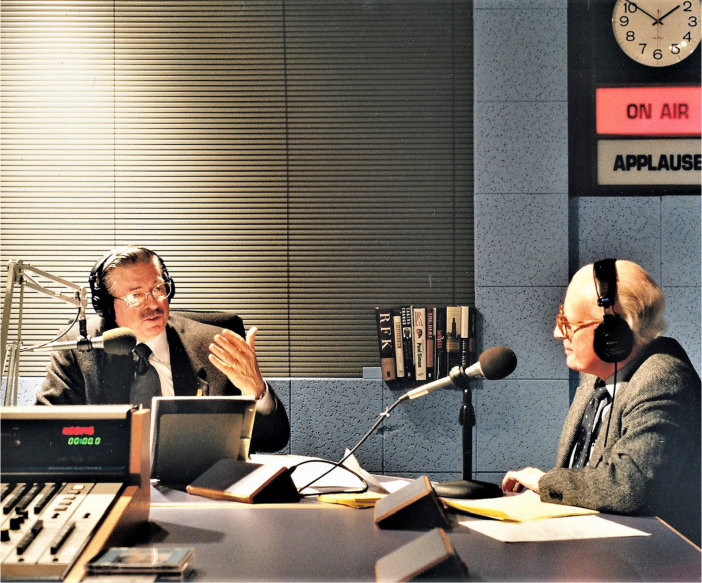
January 6 Chuck tells listeners that he has been seeking a new broadcast outlet for TWTD, but there’s no news yet.
January 10 Chicago Sun-Times columnist Robert Feder writes:
There might be encouraging news for fans of Chuck Schaden’s Those Were the Days. Although the sale of WNIB-FM will force the old-time radio showcase off the station after 25 years, Schaden isn’t ready to call it quits. “We’ve had a number of calls from, and contacts with, Chicago area stations, and are in the process of finding a suitable place for the program” he said.
January 27 Chuck announces that TWTD will begin broadcasting on College of DuPage public radio station WDCB, Glen Ellyn, Illinois, effective with the close of programming on WNIB, date to be determined, and will continue uninterrupted.
February 2 Chicago Tribune “Tempo” writer Liam Ford reports:
Late last year. Chuck Schaden thought about stowing his radio show, Those Were the Days, in what he calls his “trunkful of memories” Maybe it was time, he thought, that his program join Fibber McGee and Molly, Gunsmoke, Lights Out and so many other long-gone programs. For most of the last 31 years, Schaden’s program has aired on WNIB-FM. When a Utah -based broadcasting company bought the mostly classical music station in November for $165 million, Schaden considered leaving his adopted profession. Listeners, however, barraged him with questions about where he would take his program next, so Schaden reconsidered. Beginning this Saturday, the show will be simulcast on WNIB and its new home, WDCBFM, until the WNIB sale goes through. Fellow broadcasters say Schaden has saved a mammoth swath of radio history. [Bruce] DuMont notes that Schaden donated 50,000 hours of classic radio programs to the Museum [of Broadcast Communications] 15 years ago, forming the “foundation of our archives.” The same passion for sharing his love with others that so endears Schaden to his listeners compelled him to find new outlets for classic radio. That passion has helped his show survive longer, almost, than the 30-year Golden Age itself. It has made Those Were the Days what WNIB co-founder Sonia Florian says is one of the highest-rated programs on the station.
February 3, 10 Final Those Were The Days broadcasts on WNIB, Chicago. The last two programs on WNIB are simulcast on station WDCB to acquaint listeners with the new home for TWTD. This is also the beginning of another Jack Benny Month on TWTD and, once again, “Jack Benny” (courtesy of John Sebert) calls, this time to discuss the change of station with Chuck.
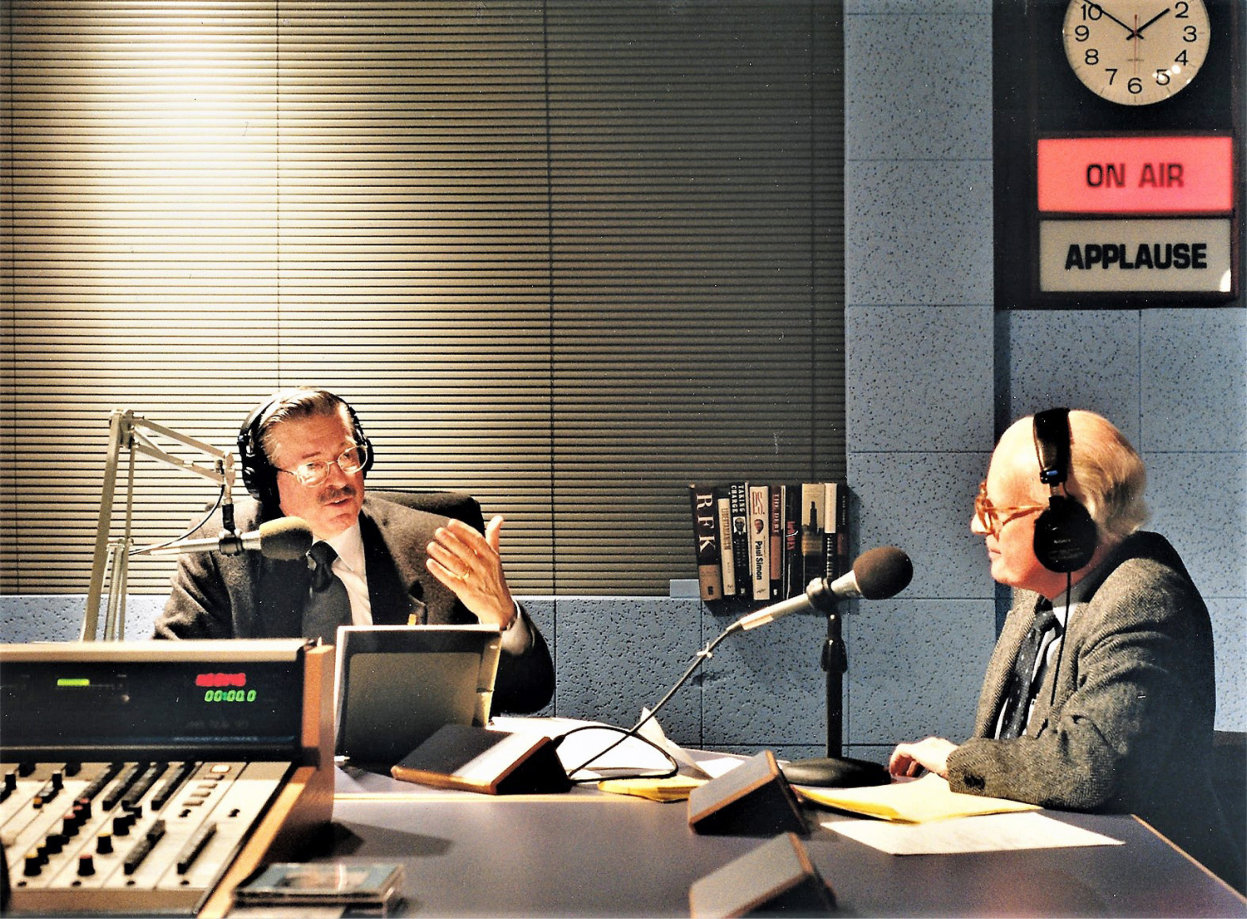
Chuck and Ken Alexander on final WNIB broadcast.
February 10 Final TWTD program on WNIB, Chicago after 1,328 programs. Chuck reminisces about WNIB as the station prepares to sign off Sunday at Midnight. Various “celebrity” listeners drop by to wish the program well on the new station: Mr. Peavey, Arthur Godfrey, Peter Lorre, Joe Friday, Brit Ponsett, and Fred Allen (all courtesy of Ken Alexander).
February 17 First “official” Those Were The Days program on station WDCB. The show continues to originate from the Radio Hall of Fame studio at the Museum of Broadcast Communications in the Chicago Cultural Center. The program keeps its original format and 1-5 p.m. Saturday time slot.
February 24 On the final Saturday of Jack Benny Month for 2001, the Those Were The Days Radio Players present “The Horn Blows at Midnight.”
April 21 Ken Alexander’s first “newspaper” report on TWTD. He tells of news and events of June 11, 1952, the date of a Red Skelton Show about to be broadcast. This initial segment grows into a regular feature as Ken brings a newspaper from his basement collection to the studio each week thereafter.
May 26 TWTD presents the first chapter of an 18-part Armed Forces Radio series, “The Glenn Miller Story.”
August 4 TWTD guest is Carl Amari, marking 20 years as an old time radio program host and founder of Radio Spirits.
September 8-15 TWTD sponsors a listener trip to Italy for visits to Rome, Florence and Capri with extensive sight-seeing, including a visit to the Vatican. A few days before the start of the trip, Chuck developed a severe case of the flu and he and Ellen are unable to accompany the group. Chuck’s brother, Ken Schaden, and his daughter Marguerite, stepped in and hosted the tour. The dramatic and tragic events of September 11 shocked and worried the TWTD travelers and their families back home, but everyone was relieved when all returned safely on the scheduled day, despite the air embargo that had been in effect for a time.
September 15 TWTD presents “Rally Around the Flag,” pre-empting scheduled programming to devote a special patriotic broadcast following the terrorist attacks on the World Trade Center in New York, the Pentagon and Pennsylvania.
October 13 For the 60th anniversary of the start of World War II, TWTD begins another series of U. S. wartime radio programming as “Storm Clouds Gather” in 1938.
October 21 Chuck and Ellen Schaden host TWTD travelers from the September listener trip to Italy for a reunion dinner at Don Roth’s Blackhawk Restaurant, where photos and memories of the unforgettable journey were shared.
December 22 WDCB’s antenna tower collapses during a heavy wind storm while TWTD was on the air. The station is off the air for five days, after which it is back on the air with all of its programming, including TWTD, intact but at reduced power from a temporary antenna.
December 27 Chicago Sun–Times columnist Robert Feder writes:
As the College of DuPage prepares to celebrate the 25th anniversary of WDCB-FM, a gust of wind knocked the public radio station off the air for five days. The station eventually resumed broadcasting its jazz and eclectic programming, but it will be operating at substantially reduced power for at least several weeks. Strong winds and aging equipment caused the station’s 310-foot transmitter tower in west suburban Glen Ellyn to collapse at about 3 p.m. Saturday. Chuck Schaden was in the midst of his Those Were the Days radio show when WDCB went off the air. He continued his Christmas program, however, for the benefit of his audience at the Museum of Broadcast Communications and for his archival tape. A college spokesman estimated the cost of a replacement tower at $100,000.